
10 easy perennial flowers that come back every year 🌸🐝
Perennials are a gardener’s best friend: plant them once, and they come back year after year, often bigger and more beautiful each time. Many of them are loved by bees and butterflies too. Here are my 10 easiest perennials – all hardy in our Nordic climate and perfect for beginners. 💕
My top 10 🌷
🌸 1. Peony
The queen of the early summer garden, with huge, fragrant flowers. Plant in a sunny spot and don’t plant it too deep – the buds should be just 3–5 cm below the soil. A peony can live for 50 years or more!
💜 2. Catmint (Nepeta)
Soft blue-purple flowers from June to September, and a bee magnet. Cut it back after the first flowering and it blooms again. Loves sun and dry soil.
💙 3. Cranesbill (Geranium)
One of the most trouble-free perennials there is. Varieties like ‘Rozanne’ flower all summer long and cover the ground so weeds can’t grow.
💚 4. Lady’s mantle (Alchemilla)
Soft, velvety leaves that catch raindrops like little pearls, and frothy lime-green flowers. Grows in sun or half-shade – lovely along paths.
🌸 5. Coneflower (Echinacea)
Pink daisy-like flowers in late summer, loved by butterflies. Leave the seed heads over winter for the birds. Needs sun.
🌼 6. Black-eyed Susan (Rudbeckia)
Bright golden flowers with dark centres from August to October – a ray of sunshine in the autumn garden.
🧡 7. Daylily (Hemerocallis)
Almost impossible to kill! Each flower lasts only a day, but new ones keep coming all summer. Grows in sun or half-shade.
🌺 8. Stonecrop (Sedum)
Fleshy leaves and flat pink flower heads in late summer and autumn – one of the best plants for bees and butterflies. Loves sun and copes with drought.
🤍 9. Yarrow (Achillea)
Flat flower heads in white, pink, yellow or red. Very hardy, drought-tolerant and wonderful for pollinators. A classic medicinal herb too. 🌿
💜 10. Lavender
Fragrant, beautiful and calming. Plant in full sun in well-drained soil, and trim lightly after flowering to keep it neat. Dry the flowers for little sleep pillows! 😴
My best tips for planting perennials 🌿
- Plant in spring or early autumn – when the soil is moist and warm.
- Read the label – sun, half-shade or shade? Right plant, right place is the secret.
- Plant in groups of 3, 5 or 7 of the same kind – it looks much more natural and calm.
- Water well the first summer while the roots grow.
- Don’t tidy too much in autumn – old stems and seed heads give shelter and food for insects and birds over winter. 🐦
- Divide every few years – and you get free new plants to share with friends! 🎁
Grow your own food too in my post 10 Easy Vegetables Anyone Can Grow. 🥕
Planting tips for perennials
- Best time: spring or early autumn, when the soil is moist and warm.
- Dig a generous hole twice the size of the pot and mix in some compost.
- Water well the first summer – after that most perennials manage on their own.
- Plant in groups of 3, 5 or 7 of the same kind – it looks calmer and more natural.
Plan for flowers all season
- Spring: bleeding heart, lungwort, primroses
- Early summer: peonies, lupins, cranesbill
- High summer: lavender, catmint, coneflower
- Late summer–autumn: asters, sedum, Japanese anemones
Plants for bees and butterflies
Catmint, lavender, coneflower, sedum and asters are bee magnets. Leave some seed heads standing over winter – they look beautiful with frost and feed the birds.
FAQ
When should I cut back perennials?
In early spring, before new growth starts. Old stems protect the plant and insects over winter.
How do I divide them?
Every 3–4 years in spring, dig up big clumps, split them with a spade and replant – free new plants!
🛍️ From my Etsy shop
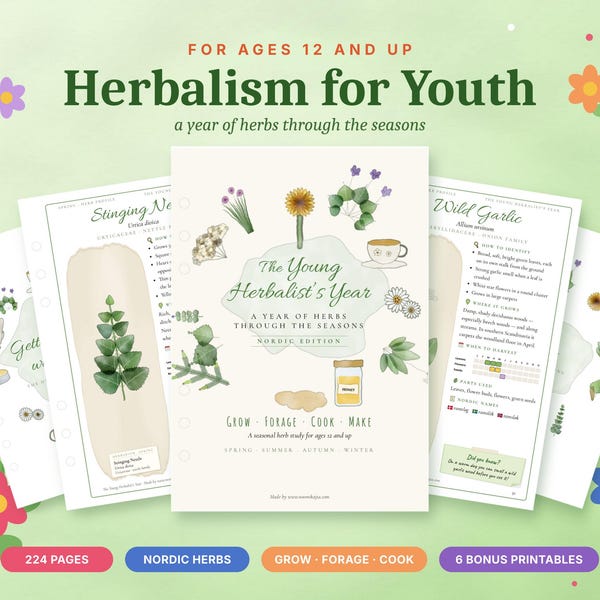
The Young Herbalist’s Year
A printable herb study for curious young minds – learn about herbs, teas and plants through the seasons.
Happy gardening! 🌸 Tag me #NoomiKajsa
With love from Bornholm,
Noomi Kajsa