Have you ever felt your whole body relax to the sound of a singing bowl, the sea or a beautiful piece of music? Sound is vibration – and for thousands of years, people have used sound, chanting and drumming to calm, heal and celebrate. 🎶
Today “healing frequencies” are everywhere on YouTube and Spotify. Here is my gentle guide to the most popular ones – and what they are traditionally used for.
The Solfeggio frequencies
The Solfeggio scale is a set of tones said to come from ancient chants. Each frequency is linked to a quality or intention:
- 174 Hz – grounding and a feeling of safety; used for tension and discomfort.
- 285 Hz – associated with renewal and restoring the body.
- 396 Hz – letting go of fear and guilt; linked to the root chakra.
- 417 Hz – change and clearing old patterns; sacral chakra.
- 528 Hz – the “love frequency”; associated with harmony, peace and transformation.
- 639 Hz – relationships, connection and the heart chakra.
- 741 Hz – expression, clarity and the throat chakra.
- 852 Hz – intuition and inner calm; third-eye chakra.
- 963 Hz – spiritual connection; crown chakra.
432 Hz – the “natural” tuning
Most modern music is tuned to 440 Hz. Many people find music tuned to 432 Hz softer and warmer, and use it for relaxation and meditation.
Brainwaves and binaural beats
Our brain works in different rhythms, measured in Hz (cycles per second):
- Delta (0.5–4 Hz) – deep, dreamless sleep and recovery.
- Theta (4–8 Hz) – deep relaxation, meditation and creativity.
- Alpha (8–12 Hz) – calm, relaxed awareness.
- Beta (12–30 Hz) – active thinking and focus.
- Gamma (30–100 Hz) – high concentration and learning.
Binaural beats play two slightly different tones in each ear (for example 200 Hz and 206 Hz), and the brain “hears” the difference – here 6 Hz, a theta rhythm. They are used to support sleep, relaxation or focus. You need headphones for them to work.
What does science say?
Honestly: research on specific “healing” frequencies is still limited, and claims such as “528 Hz repairs DNA” are not proven. What is well documented is that calm music and sound can lower stress, slow the breath and heart rate and help us fall asleep – and that is already a wonderful gift. Think of frequencies as a lovely relaxation tool, not a medicine.
How to listen
- Find a quiet spot, lie down or sit comfortably and close your eyes.
- Use soft volume – sound should feel like a hug, not a push.
- Start with 10–20 minutes; at bedtime try delta or 174 Hz.
- Combine with slow breathing: in for 4, out for 6.
Make your own frequency ritual
- Choose a quiet time – morning or before bed.
- Light a candle or dim the lights.
- Put on a frequency track or a singing bowl recording (10–20 minutes).
- Lie down, place one hand on your heart and one on your belly.
- Breathe slowly and simply notice the sound and the vibration.
- Finish by writing one word about how you feel.
Other ways to use sound
- Singing bowls – play one yourself and feel the vibration in your hands.
- Humming and chanting – your own voice is a powerful instrument.
- Nature sounds – waves, rain and birdsong are wonderfully calming.
- Sound baths – many yoga studios offer group sessions with gongs and bowls.
FAQ
Do I need headphones?
Only for binaural beats. Solfeggio and 432 Hz music can be played through normal speakers.
Can I sleep with it on?
Yes – choose a soft track with a timer so it switches off by itself.
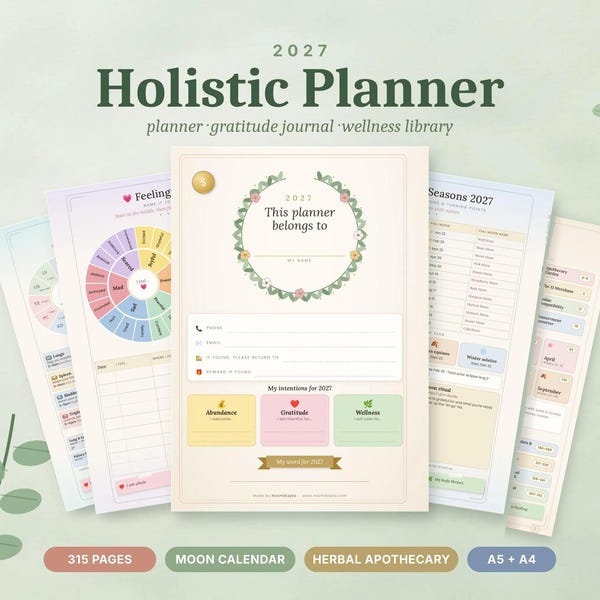
🛍️ From my Etsy shop
Holistic Planner 2027
A printable A5 planner for body and soul – mood and habit tracker, gratitude journal and herbal apothecary pages.
Which frequency is your favourite? Tag me #NoomiKajsa 🎶
Read more: How to Use Tuning Forks for Relaxation · Mind & Mood