
Honey has been loved as both food and medicine for thousands of years. But one honey has become a true favourite in natural health: manuka honey from New Zealand. 🍯
So what makes it so special – and is it worth the price? Here is my simple guide.
What is manuka honey?
Manuka honey is made by bees that collect nectar from the flowers of the manuka bush, which grows wild in New Zealand and parts of Australia. It is darker, thicker and a little more earthy and bitter in taste than ordinary honey.
What makes it unique is a natural compound called methylglyoxal (MGO). All honey has some natural antibacterial activity, but manuka honey’s MGO gives it an extra, more stable strength – which is why it is so well studied.
Traditional and modern uses
- A soothing spoon for the throat – a teaspoon on its own or in warm (not hot) tea is a classic for a scratchy throat and coughs.
- Small cuts and burns – medical-grade, sterile manuka honey is used in some wound dressings. At home, choose a sterile wound product from the pharmacy rather than the honey jar from the kitchen.
- Skin care – a thin layer as a 10-minute face mask is a gentle, moisturising treat.
- Everyday sweetener – lovely on yoghurt, porridge or a slice of rye bread.
How to choose a real manuka honey
Because manuka honey is expensive, there are many copies. Look for:
- A grading on the label – UMF™ (e.g. UMF 10+) or MGO (e.g. MGO 263+). The higher the number, the stronger (and pricier) it is.
- Made and packed in New Zealand.
- For everyday use, UMF 5+–10+ (MGO 83–263) is plenty. Save the high grades for when you feel you need a little extra.
FAQ
How much should I take? Many people enjoy 1–2 teaspoons a day. Remember, it is still sugar.
Can I put it in hot tea? Let the tea cool a little first – very high heat can weaken the delicate compounds.
Does it expire? Honey keeps for a very long time. Store it at room temperature with the lid on; crystallising is natural.
Manuka vs. ordinary honey
All honey has natural antibacterial activity, mostly from small amounts of hydrogen peroxide. Manuka is special because of its high level of methylglyoxal (MGO), which stays stable even when exposed to heat and light. Ordinary raw local honey is still a lovely food – full of flavour and pollen from your area – and much cheaper for everyday sweetening.
Understanding the labels
- UMF 5+ / MGO 83+ – mild, good for everyday use.
- UMF 10+ / MGO 263+ – medium strength, nice in winter.
- UMF 15+ / MGO 514+ – strong, for when you want extra support.
- UMF 20+ / MGO 829+ – very strong and expensive.
Little manuka rituals
- A spoon straight from the jar on a scratchy-throat morning.
- Stirred into warm lemon and ginger water.
- A thin layer as a 10-minute face mask.
- Mixed with cinnamon on toast for a cosy breakfast.
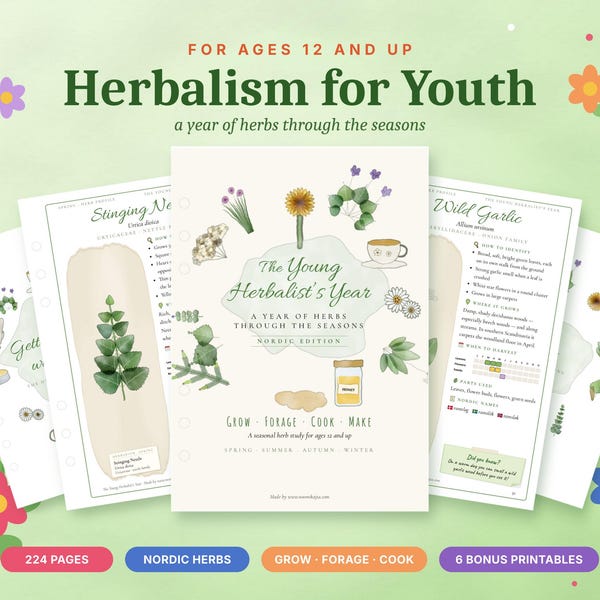
🛍️ From my Etsy shop
The Young Herbalist’s Year
A printable herb study through the seasons – grow, forage, cook and make with Nordic herbs.
Do you have a favourite way to enjoy honey? Tag me #NoomiKajsa 🍯
Read more: 10 Calming Herbal Teas for Anxious Days · Herbs & Remedies